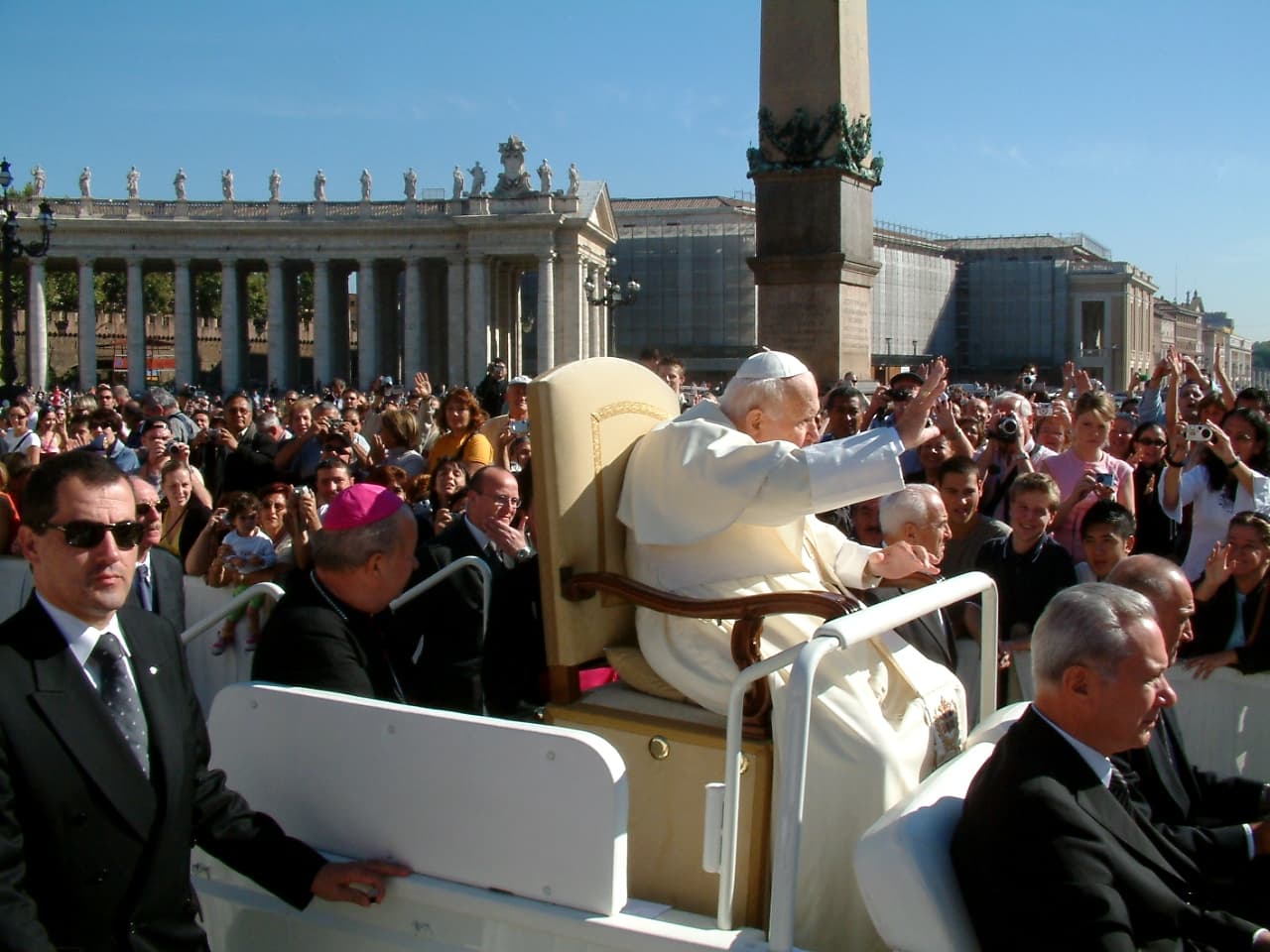
Sister Marie Simon-Pierre: Parkinson's Reversed After John Paul II Prayer
Photo: Radomił Binek · CC BY-SA 3.0
The story
Skip to the verdict ↓A French nun with rapidly advancing Parkinson's disease wrote legibly and was free of symptoms overnight after her congregation prayed to the recently deceased John Paul II.
Sister Marie Simon-Pierre Normand, a French member of the Little Sisters of Catholic Motherhood, was diagnosed with Parkinson's disease in 2001. By early 2005, her left side had become severely affected — her handwriting was illegible, her left leg stiffened while driving, and she struggled to complete her nursing duties. She described the period after John Paul II's death on April 2, 2005, as especially bleak, with her symptoms worsening noticeably.
On the night of June 2, 2005 — two months to the day after the pope's death — her congregation gathered to pray for his intercession. A voice inside her urged her to try writing his name. What she produced was clear. By morning she felt entirely normal, returned to full nursing duties within days, and remained symptom-free. Her superiors immediately reported the event to the diocesan tribunal.
The subsequent Vatican investigation lasted roughly a year. Neurologists, a neuropsychiatrist, a psychiatrist, and a handwriting expert examined her. The Consulta Medica declared the healing "scientifically inexplicable." Pope Benedict XVI signed the decree on January 14, 2011, and John Paul II was beatified on May 1, 2011.
Genuinely contested — both whether it happened and whether nature explains it.
Reviewer Notes
Miracles Jar weighs each claim two ways — how extraordinary it would be, and how strong the evidence is.
Assessed by Miracles Jar AI
Strongly attested by multi-specialist Vatican panel; spontaneous remission of Parkinson's is rare but not impossible, keeping uncertainty real.
The Consulta Medica — including non-Catholic neurologists, a neuropsychiatrist, a psychiatrist, and a handwriting expert — examined her over approximately one year and unanimously declared the cure scientifically inexplicable; a multi-specialist panel with handwriting analysis is methodologically rigorous by religious-investigation standards. Parkinson's disease is defined as progressive and incurable, making overnight resolution extraordinary. Against: Parkinson's symptoms can fluctuate, and misdiagnosis (e.g., drug-induced parkinsonism, atypical tremor disorder) occurs in 15–25% of clinical cases; original diagnostic records are not publicly accessible for independent review. The reported cure was temporally linked to intentional prayer rather than any change in treatment; temporal correlation is suggestive but not causally decisive. Misdiagnosis or atypical presentation cannot be fully ruled out, which is what keeps uncertainty real despite strong attestation.
Parkinson's disease is misdiagnosed in a meaningful fraction of cases — 15–25% by some clinical estimates — and the underlying records are not independently accessible. No mechanism is proposed beyond intercession. The strength of this case rests almost entirely on the Vatican's own investigative process, which, while multi-specialist, is not blind or adversarially designed.
Evidence ledger — what the verdict rests on
Vatican Consulta Medica — including non-Catholic specialists — unanimously declared the cure scientifically inexplicable after approximately one year of investigation.
Multi-specialist panel with handwriting analysis is methodologically rigorous by religious-investigation standards.
Parkinson's disease is defined as progressive and incurable, making overnight resolution extraordinary.
Parkinson's symptoms can fluctuate; misdiagnosis (e.g., drug-induced parkinsonism, atypical tremor disorder) occurs in 15–25% of clinical cases.
Original diagnostic records are not publicly accessible for independent review.
The reported cure was temporally linked to intentional prayer rather than any change in treatment.
Temporal correlation is suggestive but not causally decisive.
What would raise the meter: Independent diagnostic confirmation from before the event — imaging, biopsy, a second named clinician — would raise this substantially.
What would lower it: Records showing the original diagnosis was provisional or never independently confirmed would move it down.
How we weigh every claim — the full method, deductions and all →
The natural explanation
The leading natural account for this case is misdiagnosis & the overstated prognosis. Read what it explains — and where it stops.
Sources
Tagged by proximity to the event. Primary sources are direct or contemporaneous; tertiary are downstream retellings.
- 1.Primarytestimony
"My Miraculous Cure", 2011· no public link
First-person account by Sr. Marie Simon-Pierre on DivineMercy.org; establishes the timeline and subjective experience but is not independent.
- 2.Secondarynews
ABC News, "Two Women Helped Put Pope John Paul II on the Path to Sainthood", 2014· no public link
Summarizes Vatican medical process; does not access original medical records.
- 3.Secondarychurch document
"The Miracle of John Paul II", 2011· no public link
Catholic Exchange overview of the Vatican decree; useful for procedural details.
Cases like this
Nearest on the map — similar in how miraculous they’d be, and how strong the evidence is.