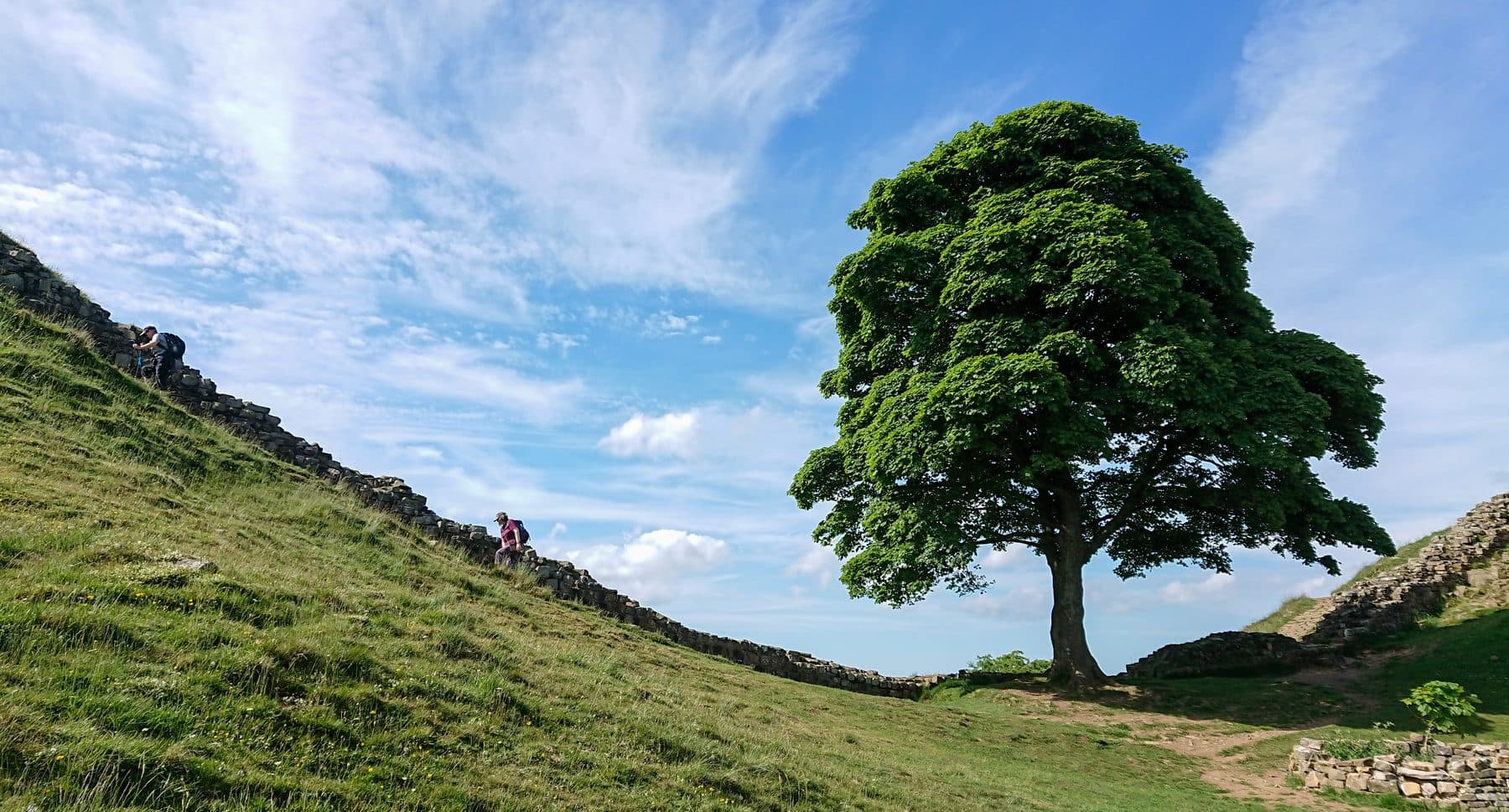
Sycamore Gap — The Felled Tree That Sprouted (2023–2024)
Photo: Gordon Leggett / Wikimedia Commons · CC BY-SA 4.0
The story
Skip to the verdict ↓England's most photographed tree, the sycamore standing in a dip of Hadrian's Wall for well over a century, was illegally felled with a chainsaw in the early morning of September 28, 2023; ten months later a National Park ranger found twelve new shoots growing from the base of the stump. The two men who cut it down were convicted of criminal damage in May 2025 and sentenced to four years and three months each, and the first seedling grown from the tree's seeds was presented to King Charles III.
The Sycamore Gap tree, which had grown in a dip of Hadrian's Wall for well over a hundred years, was felled with a chainsaw in the early morning of September 28, 2023. Ten months later, a ranger on a routine visit found twelve new shoots growing from the base of the stump.
The felling is documented to the minute, because the man who drove there filmed it. Daniel Graham, 39, and Adam Carruthers, 32, both experienced tree surgeons, drove from the Carlisle area to the Steel Rigg car park during Storm Agnes on the night of September 27 and walked the fifteen to twenty minutes to the tree. Carruthers cut; Graham filmed. The video on his phone was created at 00:32, and the cut took no more than three minutes. The trunk fell across Hadrian's Wall, a World Heritage Site, fracturing stones with repair costs put at just under £7,500. The two men took a wedge of the trunk away as a trophy. On the drive home, Carruthers's partner sent him a video of their newborn being fed. He replied: 'I've got a better video than that.'
A jury convicted both men of two counts of criminal damage on May 9, 2025. On July 15, Mrs Justice Lambert sentenced each to four years and three months. Her sentencing remarks fix the harm she weighed most: not the timber value but the social impact — a public reaction of 'widespread shock and bewilderment,' an outpouring the National Trust's Andrew Poad called unprecedented in the Trust's experience. The tree had won England Tree of the Year in 2016. It was a place where marriages were proposed and where people left tributes to their dead.
The Shoots
In late July 2024, ranger Gary Pickles found new growth at the stump. The Northumberland National Park Authority announced twelve shoots at the base, each with one to six small leaves, two to four centimeters high. 'I was first at the scene when the tree was discovered felled,' Pickles said. 'Now, I hope I can say that it's back!' Poad called it 'such welcome news to see that the stump has started to regenerate,' and laid out the plan: leave all twelve shoots to grow for a few years and see how they develop. The site was fenced, visitors were asked not to touch the shoots, and seeds collected from the felled tree were already growing into saplings — the first seedling was presented to King Charles III for planting in Windsor Great Park.
After the Felling
The National Trust dates the tree's planting to the late nineteenth century, and published ages run from about 100 to about 150 years. A broadleaf tree cut at the base reshoots from dormant buds in the stump; coppicing — cutting a tree precisely so that it will regrow — is how broadleaf woodland was harvested for centuries, and sycamore regrows vigorously. From the first weeks, the land managers fenced the stump, asked visitors to keep their distance, warned that scattered ashes could hinder the growing process, and put seeds into propagation. Twelve shoots appeared in the first growing season after the felling. The same ranger who was first at the scene when the felled tree was discovered was the one who found the new growth at the stump.
It happened — best read as remarkable timing, not the miraculous.
Reviewer Notes
Miracles Jar weighs each claim two ways — how extraordinary it would be, and how strong the evidence is.
Assessed by Miracles Jar AI
The shoots are ordinary coppice regrowth from a healthy stump, which the land managers anticipated and protected for; what was genuinely exceptional, a court found, was the scale of public grief for a tree — and the regrowth mattered because the grief did.
The regrowth is ordinary coppice biology. Sycamore regrows vigorously from healthy stumps; the land managers at the National Trust anticipated it and protected the stump for exactly this reason. The twelve shoots — one to six leaves each, two to four centimeters — appeared by late July or August 1, 2024, less than a year after the tree was felled on the night of September 27–28, 2023. That timing is within normal range for a healthy sycamore stump; National Trust woodland manager Gary Pickles described the regrowth as expected and confirmed the plan to leave all twelve shoots to grow for a few years to see how they develop.
What was genuinely exceptional, a court found, was the scale of public grief for a tree. Mrs Justice Lambert's sentencing remarks treated that grief as the principal harm of the offense — the reason Daniel Graham, 39, and Adam Carruthers, 32, each received four years and three months on May 9, 2025. Andrew Poad of the National Trust called the sentence unprecedented. King Charles III expressed sadness at the loss. The tree had stood at Sycamore Gap on Hadrian's Wall for an estimated 100 to 150 years, planted in the late 19th century.
The regrowth's significance was not botanical. Twelve shoots on a stump answered a public grief that the botany textbooks do not measure. The criminal court's treatment of that grief as the central harm of a vandalism case is itself an unusual fact in the documented record — and not one the shoots' biology explains.
Evidence ledger — what the verdict rests on
The felling, the offenders' conduct and the public impact are fixed by a Crown Court's findings of fact, the strongest documentary footing in this entry's class
Convictions May 9, 2025; sentences of 4 years 3 months on July 15, 2025
Regrowth from a cut broadleaf stump is ordinary coppice biology — the deliberate basis of centuries of woodland management — and sycamore is a vigorous regrower
Twelve shoots in the first growing season after the felling
The land managers anticipated and protected for regrowth from the start: fencing, hands-off management of all twelve shoots, seed propagation already under way
Poad: 'Our aim is to leave all 12 shoots to grow for a few years'
The court treated the public grief as the offense's principal harm — an unprecedented outpouring in the National Trust's experience, at a site where tributes to the dead were left — which is the documented scale of the meaning the regrowth answered
The judge uplifted the sentence for the 'extraordinary social impact'
The believer-side residue is the timing of an ordinary process landing on an extraordinary need: the same ranger who found the felled tree found the shoots
Pickles: 'I hope I can say that it's back!'
What would raise the meter: Long-term follow-up documenting permanence, in a condition with a near-zero spontaneous-resolution base rate, would raise the meter.
What would lower it: A documented relapse, or case literature showing the condition fluctuates or remits on its own, would move it down.
How we weigh every claim — the full method, deductions and all →
The natural explanation
The leading natural account for this case is spontaneous remission & the body's own recovery. Read what it explains — and where it stops.
Sources
Tagged by proximity to the event. Primary sources are direct or contemporaneous; tertiary are downstream retellings.
- 1.Primaryother
The court's findings of fact: the tree's century-plus age, the 00:32 felling video during Storm Agnes, the 2.5-to-3-minute cut, the trophy wedge, the 'I've got a better video than that' message, the just-under-£7,500 wall damage, the May 9, 2025 convictions, and the four-years-three-months sentences of July 15, 2025
- 2.Primaryother
Northumberland National Park Authority, "Sycamore Gap is sprouting!", 2024
August 1, 2024: ranger Gary Pickles's discovery on a routine visit, the twelve shoots with one to six leaves each at 2–4 cm, Andrew Poad's 'the stump has started to regenerate' and the plan to leave all twelve shoots to grow, plus the fencing and the request that visitors not leave ashes
- 3.Secondaryother
Wikipedia, "Sycamore Gap tree — Wikipedia", 2026
Consolidated record: the late-19th-century planting and the 100-to-150-year age range, the 2016 England Tree of the Year award, the August 2024 regrowth, the trial timeline, and the first seedling presented to King Charles III for Windsor Great Park
Cases like this
Nearest on the map — similar in how miraculous they’d be, and how strong the evidence is.