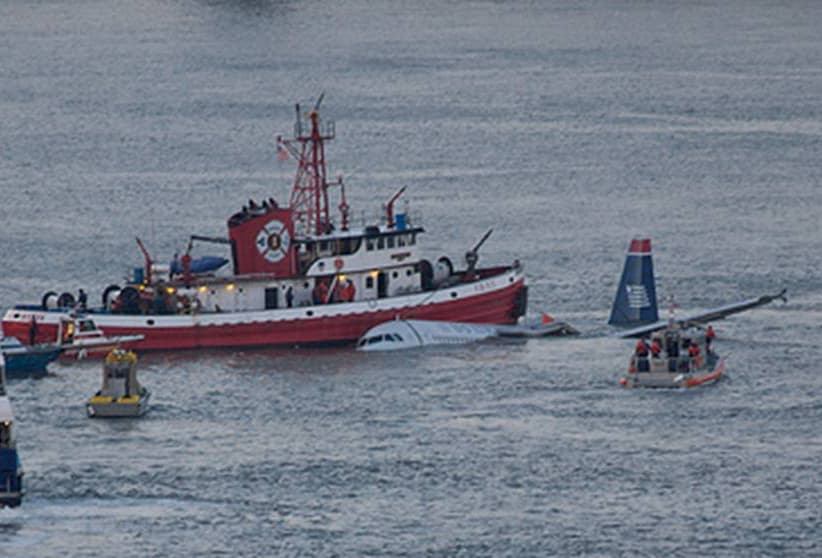
Miracle on the Hudson — US Airways Flight 1549
Photo: USCG Press / U.S. Coast Guard via Wikimedia Commons · CC BY 2.0
The story
Skip to the verdict ↓At 15:27 on 15 January 2009, climbing out of LaGuardia, US Airways Flight 1549 flew into a flock of Canada geese, and both engines of the Airbus fell silent within seconds. Captain Chesley Sullenberger took the controls. There was no altitude to reach a runway, only the city below and a river running past it. Minutes later, his transmission to the tower was clipped and flat: 'We're gonna be in the Hudson.'
The Flight and the Strike
US Airways Flight 1549 lifted off from LaGuardia Airport's Runway 4 at 15:24:56 EST on 15 January 2009, bound for Charlotte, North Carolina, with 150 passengers and a crew of five aboard an Airbus A320-214 (registration N106US). Captain Chesley "Sully" Sullenberger, 57, had 19,663 total flight hours and 4,765 hours on the A320 type. First Officer Jeffrey Skiles, 49, brought more than 20,000 total hours to the cockpit, though only 37 on the A320 following a recent type transition.
At 15:27:01, climbing through approximately 2,818 feet some 4.5 miles north-northwest of LaGuardia, the aircraft flew into a flock of Canada geese. The collision was nearly simultaneous across both CFM56 turbofan engines. Each ingested birds estimated at roughly 8 pounds — heavier than the certification test standard — and lost nearly all thrust within seconds. Sullenberger immediately took the controls. His radio transmission at 15:27:36 was clipped and final: "We're gonna be in the Hudson."
Simulator reconstructions later showed that a return to LaGuardia succeeded in only 7 of 13 attempts even with pilots who knew in advance what was coming. Diversion to Teterboro, across the river in New Jersey, succeeded in only 1 of 2. With no engine restart, no altitude to spare, and the city spread below, the river was the only viable surface.
The Ditching and Rescue
Sullenberger configured for best glide and activated the Auxiliary Power Unit, preserving the normal flight control law and stall protection that would otherwise have been unavailable. He aligned for the widest section of the river near West 50th Street. At 15:31, approximately 208 seconds after the bird strike, the aircraft touched down on the Hudson. It struck at roughly 13 feet per second of vertical speed; the fuselage held. All five doors and overwing exits were used for evacuation. Sullenberger walked the length of the cabin twice to confirm no one remained, then exited last.
The Hudson was unusually calm that afternoon — nearly flat, at approximately 41 degrees Fahrenheit, with a wind chill of 2 degrees. NY Waterway ferries working the midtown commuter run reached the floating aircraft in approximately three to four minutes. Fourteen NY Waterway vessels ultimately responded; the United States Coast Guard and the New York City Fire Department accounted for the remainder. The final survivor was pulled from the water by 15:55 — twenty-four minutes after ditching. Of 155 aboard, 100 sustained injuries: 5 serious, 95 minor. None died.
The Investigation
The NTSB's final report (AAR-10/03, 2010), accident number DCA09MA026, identified the probable cause as bird ingestion causing near-total thrust loss in both engines. It credited four factors with the successful outcome: crew decision-making and crew resource management, the aircraft's forward slide-raft configuration, effective cabin crew evacuation management, and the rapid arrival of emergency responders. The aircraft carried forward slide-rafts because it was certificated for extended overwater operations — equipment not required for a domestic LaGuardia departure. NY Waterway ferries reached the floating aircraft within approximately three to four minutes; fourteen ferries ultimately responded, rescuing roughly 135 of the 155 occupants. The NTSB described the event as the most successful ditching in aviation history. In his 2009 memoir *Highest Duty: My Search for What Really Matters*, written with Jeffrey Zaslow, Sullenberger framed the outcome as the product of a 35-year flying career of preparation rather than fortune.
It happened — best read as remarkable timing, not the miraculous.
Reviewer Notes
Miracles Jar weighs each claim two ways — how extraordinary it would be, and how strong the evidence is.
Assessed by Miracles Jar AI
The outcome is fully explicable by the convergence of elite crew skill, favorable aircraft configuration, the geometry of a wide calm river, and an immediate ferry response — no natural law was suspended. What earns the modest authentic score is the rarity of the outcome itself: dual engine failure at low altitude over a city almost never ends this way, and the zero-fatality result reflects a genuine margin of fortune layered on top of everything the crew and rescue infrastructure supplied.
The Question
The question here is whether any element of this outcome exceeds what crew skill, training, aircraft engineering, and favorable circumstance can account for — the answer is no, though the simultaneous convergence of all favorable factors is genuinely rare.
The Case For and Against
The natural account is powerful and largely complete. The NTSB's final report (AAR-10/03) credited four factors: crew decision-making and crew resource management, the aircraft's forward slide-raft configuration, effective cabin crew evacuation management, and the rapid arrival of emergency responders. Each is traceable to human competence and institutional preparation, not to any intervention outside the natural order. Sullenberger himself wrote that the outcome was the product of a 35-year flying career — not fortune. The aircraft happened to carry slide-rafts because it was certificated for extended overwater operations, equipment not required for a domestic LaGuardia departure. The ferry response was fast because it is one of the world's busiest commuter waterways.
The honest residue is also real. Dual engine failure at low altitude over a dense city is, in the record, almost always fatal. A zero-fatality outcome for all 155 aboard in a water ditching has no modern commercial aviation precedent. The convergence of factors — crew excellence, aircraft configuration, river geometry, ferry proximity, calm water — is individually explicable but collectively rare enough to register a genuine margin beyond the routine. That margin belongs to the category of extraordinary human competence meeting favorable conditions. It does not require, and the evidence does not support, a supernatural explanation.
Where This Lands
The outcome is fully explicable by the convergence of elite crew skill, favorable aircraft configuration, the geometry of a wide calm river, and an immediate ferry response — no natural law was suspended. What gives the case its small lean toward the remarkable is the rarity of the outcome itself: dual engine failure at low altitude over a city almost never ends this way, and the zero-fatality result reflects a genuine margin of fortune layered on top of everything the crew and rescue infrastructure supplied.
The question of whether anything here transcends skill, physics, and favorable circumstance gets a low answer because it does not. The A320 glides unpowered at a substantial ratio; the Hudson on that afternoon was unusually calm; the aircraft happened to be certificated for extended overwater operations and carried forward slide-rafts it was not otherwise required to carry on a domestic routing; Sullenberger had 19,663 total flight hours including 4,765 on type; and one of the world's busiest ferry corridors ran directly alongside the ditching site. Each factor is explicable individually. The authentic residue — the honest accounting of what would have changed if any single factor had differed — is real but modest: dual engine failure at low altitude over a dense urban area is ordinarily fatal, and zero fatalities from 155 aboard is a genuinely rare outcome. That residue belongs to the category of extraordinary human competence meeting favorable conditions, not to the supernatural.
Evidence ledger — what the verdict rests on
Both engines lost nearly all thrust at 2,818 feet — too low and slow to reach any runway — making a water ditching the only physically viable option.
NTSB AAR-10/03 confirms near-total thrust loss in both engines; simulator testing showed returning to LaGuardia succeeded in only 7 of 13 attempts even with pilots who had advance knowledge of the scenario.
Sullenberger had 19,663 total flight hours including 4,765 on the A320; he correctly assessed glide margin, selected the only survivable surface, and activated the APU — preserving normal flight control law and stall protection throughout the descent.
NTSB credited crew decision-making and crew resource management as a primary factor in the successful outcome; APU activation was specifically identified as pivotal by aviation analysis.
The Hudson River that afternoon was unusually calm and glassy for January, and the aircraft was certificated for extended overwater operations, carrying forward slide-rafts not required on this domestic routing.
Water conditions (nearly dead calm, approximately 41°F air temperature) and the presence of slide-rafts are corroborated by NTSB and multiple secondary sources; the slide-rafts were cited by NTSB as a contributing factor to survival.
NY Waterway ferries operating on the midtown commuter corridor reached the floating aircraft in approximately three to four minutes; fourteen vessels responded and rescued roughly 135 of the 155 occupants before cold-water hypothermia became critical.
The ferry response timeline and rescue numbers are corroborated by NY Waterway records and multiple independent news reports; the speed of rescue was essential given a 41°F water temperature and a 2°F wind chill.
Dual engine failure at low altitude over a dense urban area is ordinarily fatal; zero fatalities from 155 occupants is an outcome without modern commercial aviation precedent for a water ditching.
The NTSB described this as the most successful ditching in aviation history; the rarity of the outcome — not any supernatural mechanism — is the honest residue supporting a non-zero authentic score.
What would raise the meter: Ruling out the remaining natural explanations — with records, follow-up, or base-rate math — would raise the meter.
What would lower it: A documented natural pathway for this outcome would move the meter down.
How we weigh every claim — the full method, deductions and all →
The natural explanation
The leading natural account for this case is skill, preparation & ordinary physics. Read what it explains — and where it stops.
The same wonder, across traditions
This claim is one of many that make the same assertion across faiths. See it side by side in Deliverance Against the Odds.
Sources
Tagged by proximity to the event. Primary sources are direct or contemporaneous; tertiary are downstream retellings.
- 1.Primaryinvestigation
Corroborates the accident date, LaGuardia departure, bird species (Canada geese), altitude at strike (2,818 ft), near-total loss of thrust in both engines, all 155 aboard survived, the NTSB probable cause statement, and the four factors credited with the successful outcome including crew decision-making and the presence of forward slide-rafts.
- 2.Primaryinvestigation
Corroborates accident number DCA09MA026, report designation AAR-10-03, the NTSB probable cause text, contributing factors including crew resource management, and the total of 155 occupants of whom all survived, with one flight attendant and four passengers seriously injured.
- 3.Secondaryother
Tailstrike Aviation Database, "US Airways 1549 — CVR Transcript and Accident Database Entry", 2009
Corroborates the takeoff time (15:24:56 EST), the bird-strike time (approximately 15:27:01) and altitude, Sullenberger's ATC transmission 'we're gonna be in the Hudson,' the ditching at 15:31, all 155 evacuated, and Sullenberger walking the cabin twice before exiting last.
- 4.Primarybook
Sullenberger's memoir corroborates his own account of the emergency and his framing of the outcome as the product of a 35-year career of preparation rather than miraculous intervention — directly relevant to whether this was more than fortunate timing.
Cases like this
Nearest on the map — similar in how miraculous they’d be, and how strong the evidence is.