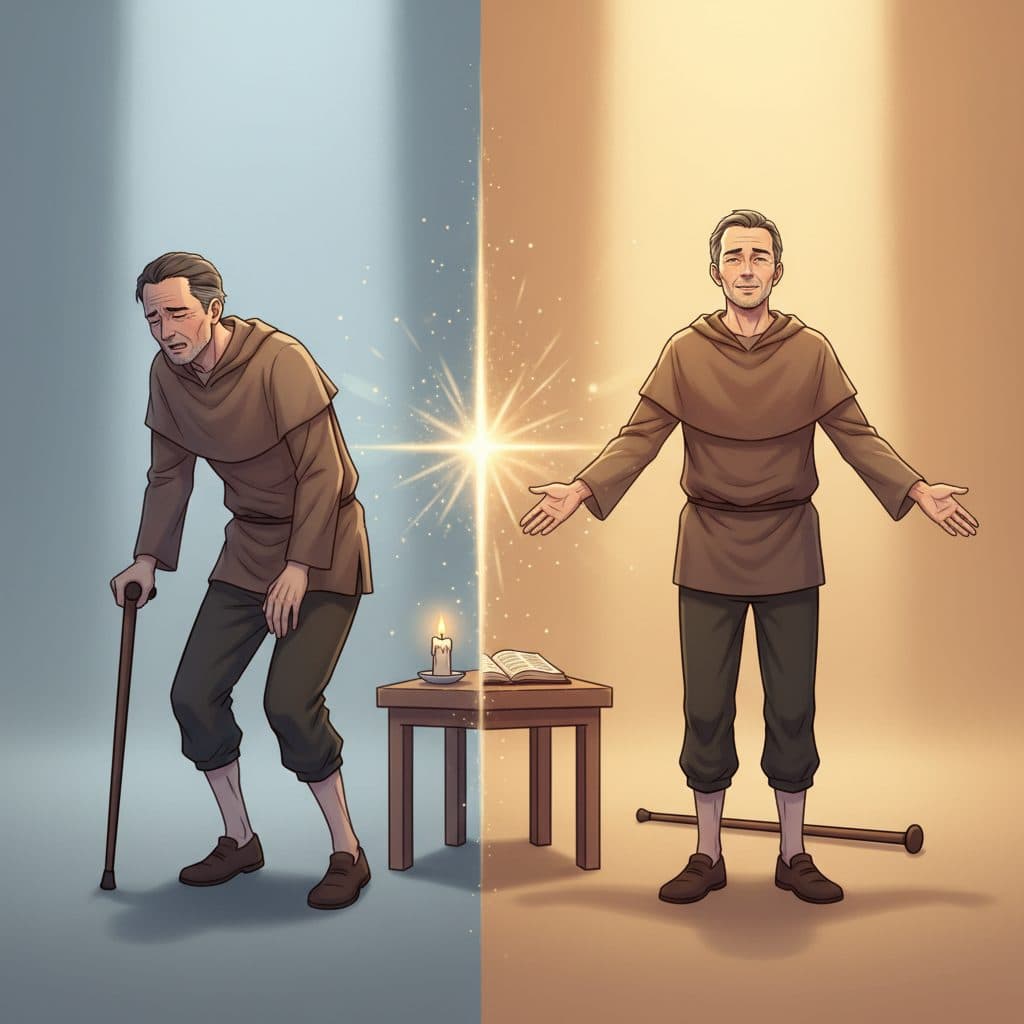
Deacon Jack Sullivan: Debilitating Spinal Stenosis Resolved After Newman Prayer
Illustration: AI-generated dramatization (Gemini Flash Image)
The story
Skip to the verdict ↓An American deacon-in-training nearly paralyzed by spinal stenosis recovered suddenly after praying to Cardinal John Henry Newman — the first miracle recognized toward Newman's canonization.
Jack Sullivan, a married American deacon candidate, awoke on June 6, 2000, with intense pain and marked leg weakness from severe spinal stenosis — a narrowing of the spinal canal compressing the cord and nerve roots. His condition deteriorated. He underwent surgery, which complicated rather than resolved his symptoms, leaving him with severe ongoing pain.
On August 15, 2001 — the Feast of the Assumption — Sullivan had been watching a television documentary about Cardinal John Henry Newman and began to pray to him. He later said he heard Newman's words about God's will as if spoken directly to him. Within minutes, his pain subsided dramatically. He returned to full function and resumed his deacon formation.
The diocesan tribunal collected medical evidence and referred the case to Rome. After a years-long review, the Congregation for the Causes of Saints announced on July 3, 2009, that the healing was "scientifically inexplicable." Pope Benedict XVI announced the recognition and Newman was beatified on September 19, 2010. Newman's canonization followed on October 13, 2019.
Genuinely contested — both whether it happened and whether nature explains it.
Reviewer Notes
Miracles Jar weighs each claim two ways — how extraordinary it would be, and how strong the evidence is.
Assessed by Miracles Jar AI
Vatican-approved with documented imaging, but spinal stenosis remission is more medically plausible than most other categories, somewhat lowering the threshold of inexplicability.
Weighing the evidence. Spinal stenosis has a meaningful rate of spontaneous symptom remission — more so than most conditions appearing in miracle files. The Vatican's conclusion of inexplicability carries weight, but independent neurologists would note that sudden symptom improvement in stenosis, while uncommon, is not unknown without surgery. This case scores lower on inexplicability than pure structural damage categories.
For authenticity. Severe spinal stenosis was documented on MRI, with near-paralysis in the legs that resolved suddenly after intentional prayer. MRI documentation is important; however, stenosis severity on imaging does not always correlate directly with clinical symptoms. The Congregation for the Causes of Saints declared the healing "scientifically inexplicable" in 2009. Sullivan's post-cure neurological improvement was verified by subsequent examination.
For a natural explanation. Spinal stenosis symptoms are known to wax and wane; spontaneous improvement without surgery is documented in the medical literature, particularly under changing posture, stress, or inflammation. Several cases of spontaneous improvement are documented in the literature without surgery. This is the primary reason the case for authenticity is moderate rather than strong.
Neutral / interpretive. Sullivan had seen a TV program about Newman and prayed specifically to him, then experienced sudden relief. The prayer-to-cure link is temporally close but causal attribution is interpretive.
Evidence ledger — what the verdict rests on
Severe spinal stenosis documented on MRI; near-paralysis in legs that resolved suddenly after intentional prayer.
MRI documentation is important; however, stenosis severity on imaging does not always correlate directly with clinical symptoms.
Congregation for the Causes of Saints declared the healing 'scientifically inexplicable' in 2009.
Spinal stenosis symptoms are known to wax and wane; spontaneous improvement without surgery is documented in the medical literature.
This is the primary reason the authentic score is moderate rather than high.
Sullivan had seen a TV program about Newman and prayed specifically to him, then experienced sudden relief.
The prayer-to-cure link is temporally close but causal attribution is interpretive.
What would raise the meter: Long-term follow-up documenting permanence, in a condition with a near-zero spontaneous-resolution base rate, would raise the meter.
What would lower it: A documented relapse, or case literature showing the condition fluctuates or remits on its own, would move it down.
How we weigh every claim — the full method, deductions and all →
The natural explanation
The leading natural account for this case is spontaneous remission & the body's own recovery. Read what it explains — and where it stops.
Sources
Tagged by proximity to the event. Primary sources are direct or contemporaneous; tertiary are downstream retellings.
- 1.Secondarynews
Catholic News Agency, "The Lifesaving Miracle That Led to St. John Henry Newman's Canonization", 2019· no public link
Detailed account of Sullivan's case; cites Vatican recognition timeline.
- 2.Primarytestimony
"Deacon Jack Sullivan's Cure", 2019· no public link
Sullivan's own account on the official Newman canonization site.
- 3.Secondarywebsite
"Canonisation of John Henry Newman — Wikipedia", 2024· no public link
Provides dates and Vatican procedural outline.
Cases like this
Nearest on the map — similar in how miraculous they’d be, and how strong the evidence is.