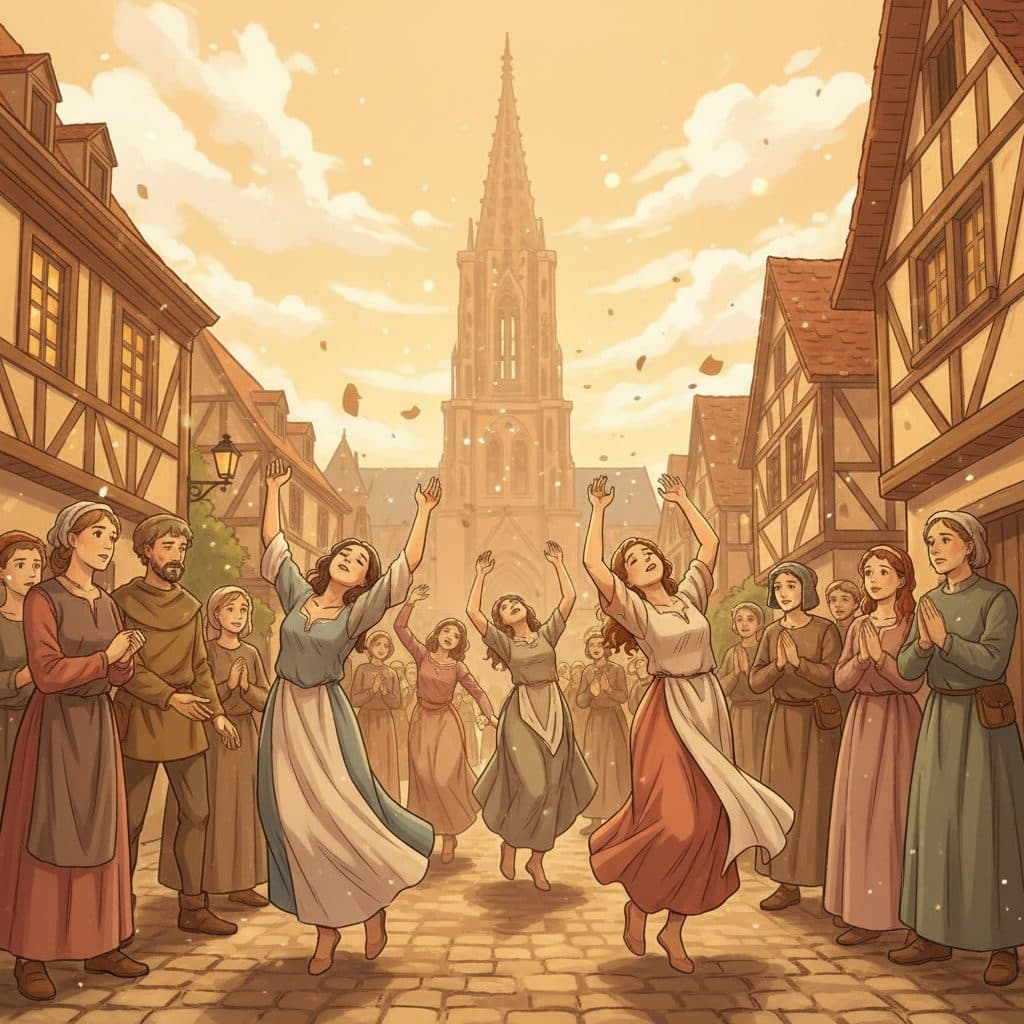
The Dancing Plague of Strasbourg, 1518
Illustration: AI-generated dramatization (Gemini Flash Image)
The story
Skip to the verdict ↓In the summer of 1518, a woman in Strasbourg — then in the Holy Roman Empire, today in France — began dancing in the street and could not stop. Within weeks dozens — and by some accounts up to 400 people — were dancing compulsively for days on end, some reportedly until they collapsed or died. The episode is firmly attested in city-council minutes, physician notes, cathedral sermons, and regional chronicles. It is not a hoax or a pure legend: something genuinely strange happened. The best modern explanation is mass psychogenic illness ("psychic contagion") fueled by famine, disease, and a widespread belief in St. Vitus's curse, rather than a supernatural cause or ergot poisoning.
In the summer of 1518, a woman in Strasbourg — then in the Holy Roman Empire, today in France — began dancing in the street and could not stop. Within weeks dozens — and by some accounts up to 400 people — were dancing compulsively for days on end, some reportedly until they collapsed or died.
The episode is recorded in the Strasbourg privy council's own minutes, in physicians' notes, in cathedral sermons, and in local and regional chronicles. These contemporary records agree that in the summer of 1518 people in the city danced uncontrollably for days. Later sources name the first dancer "Frau Troffea" and report that the affliction spread to dozens and ultimately to several hundred people.
The authorities' response is also documented. On the humoral theory that the dancers needed to "dance it out," the council first built stages and hired musicians; the outbreak worsened. The council then reversed course, banned music and public dancing, and sent the afflicted to the shrine of St. Vitus to seek a cure.
Strasbourg in 1518 had endured years of famine, floods, and outbreaks of disease — smallpox, syphilis, and plague. The population deeply feared St. Vitus, a saint believed to punish sinners by compelling them to dance.
What the contemporary records do not clearly state is the death toll. The widely repeated claim that up to fifteen people died per day, with the total running into the hundreds, traces to later chronicles — a 1636 astrological account and others — rather than to the 1518 records themselves. The first dancer's name, "Frau Troffea," and some vivid details likewise come from later writers such as Paracelsus.
It happened — and nature accounts for it.
Reviewer Notes
Miracles Jar weighs each claim two ways — how extraordinary it would be, and how strong the evidence is.
Assessed by Miracles Jar AI
Real and exceptionally well-documented for its era. Best explained as mass psychogenic illness (mass hysteria) amid extreme stress — not a miracle, and not convincingly ergot poisoning. The dramatic death toll is the one detail that rests on later, unverified chronicles.
This is a documented physical and behavioral event, not a claimed divine intervention. The question is not "did God act?" but whether there is an adequate natural account of the compulsive dancing — and there is a strong one.
The verdict: Real and exceptionally well-documented for its era. Best explained as mass psychogenic illness amid extreme stress — not a miracle, and not convincingly ergot poisoning. The dramatic death toll is the one detail that rests on later, unverified chronicles.
Why the documentation is strong
This is one of the rare cases where the underlying event is essentially beyond dispute. Multiple independent contemporary records — the Strasbourg privy council's own minutes, physicians' notes, cathedral sermons, and local and regional chronicles — agree on the uncontrolled dancing. For an event five centuries old, the documentation is remarkable. The dancing is certain; the mass fatalities are not.
The soft spot — death toll
Contemporaries did not clearly record the death toll. The claim of up to fifteen deaths per day, hundreds dead total, traces to later chronicles (a 1636 astrological account and others), not the 1518 records. Honest historians, including John Waller, flag this. The single soft spot in an otherwise solid factual record is here.
Natural account
The field has largely converged. The most influential modern study, by medical historian John Waller, argues for mass psychogenic illness — a psychic contagion that takes culturally specific forms under extreme collective stress. The famine, floods, disease, and fear of St. Vitus supplied both the stressors and the culturally specific "script" for the behavior. A trance-like compulsive behavior spreading by suggestion is a coherent and well-precedented mechanism (compare the 1962 Tanganyika "laughter epidemic" and the region's earlier choreomania outbreaks from 1374 onward).
Rival theory rejected
The competing ergotism hypothesis — poisoning by a psychoactive fungus on rye — has real problems: ergot constricts blood flow to the extremities, which is incompatible with dancing for days; it would not produce near-identical reactions across hundreds of people; rye was not a staple everywhere choreomania appeared; and the characteristic gangrene of ergot poisoning is not described. This weakens the chief rival natural theory but does not undercut the event itself.
Source criticism
The first dancer's name ("Frau Troffea") and some vivid details come from later writers such as Paracelsus, requiring source criticism. This does not undermine the core event but shows later embellishment of specifics.
Framing for readers
Treat this not as a contest between faith and fraud, but as a genuine and tragic human event. The people of Strasbourg really suffered; their contemporaries really tried, by the lights of their medicine and their faith, to help. The supernatural framing (St. Vitus's curse) was the era's explanation; the modern one (stress-driven mass psychogenic illness) fits the evidence better and leaves little that demands a miracle.
Evidence ledger — what the verdict rests on
Multiple independent contemporary records — Strasbourg city-council minutes, physician notes, cathedral sermons, and local/regional chronicles — agree the compulsive dancing occurred.
Establishes the event is real; exceptional documentation for a 1518 episode.
A widely accepted natural mechanism exists: mass psychogenic illness ('psychic contagion') under extreme collective stress, with regional precedents (choreomania from 1374) and modern analogues (1962 Tanganyika laughter epidemic).
Coherent, well-precedented account that leaves little requiring a supernatural cause.
Strasbourg in 1518 had endured famine, floods, and disease (smallpox, syphilis, plague), plus deep fear of St. Vitus, the saint believed to compel dancing — the precise conditions that breed mass psychogenic outbreaks.
Supplies the stressors and the culturally specific 'script' for the behavior.
The ergotism (fungus-poisoning) hypothesis has serious problems: ergot constricts blood flow (incompatible with dancing for days), would not yield uniform reactions across hundreds, rye was not a staple at all choreomania sites, and no characteristic gangrene is described.
Weakens the chief rival natural theory but does not undercut the event itself.
The dramatic death toll (e.g., 'up to 15 deaths per day,' hundreds dead) appears in later chronicles (1600s+), not in the contemporary 1518 records.
The dancing is certain; the mass fatalities are unverified — the main caution on the factual side.
Even the first dancer's name ('Frau Troffea') and some vivid details come from later writers such as Paracelsus, requiring source criticism.
Doesn't undermine the core event but shows later embellishment of specifics.
What would raise the meter: Documented recurrence in cases with no expectancy pathway — or records ruling out functional overlay — would raise the meter.
What would lower it: Evidence of symptom relapse, revised diagnosis, or undisclosed treatment would lower the evidence bar.
How we weigh every claim — the full method, deductions and all →
The natural explanation
The leading natural account for this case is expectation, suggestion & the placebo response. Read what it explains — and where it stops.
Sources
Tagged by proximity to the event. Primary sources are direct or contemporaneous; tertiary are downstream retellings.
- 1.Tertiarywebsite
"Dancing plague of 1518", Wikipedia
Encyclopedic overview; notably explicit that contemporary 1518 records document the dancing but not the death tolls, which derive from later accounts.
- 2.Secondarynews
"What caused Strasbourg's dancing plague of 1518?", National Geographic
Synthesizes scholarly views (Waller, Dickason, Renberg) favoring mass psychogenic illness and detailing the objections to the ergotism theory.
- 3.Secondaryacademic
Ned Pennant-Rea, "The Dancing Plague of 1518", The Public Domain Review
Source-critical essay tracing the primary chronicles (Schilter, Specklin, Paracelsus) and stating plainly that the final death toll is unknown.
- 4.Secondarybook
Waller is the leading modern historian of the event; argues for mass psychogenic illness and critiques the ergotism hypothesis (also summarized via Britannica and his Lancet work).
Cases like this
Nearest on the map — similar in how miraculous they’d be, and how strong the evidence is.