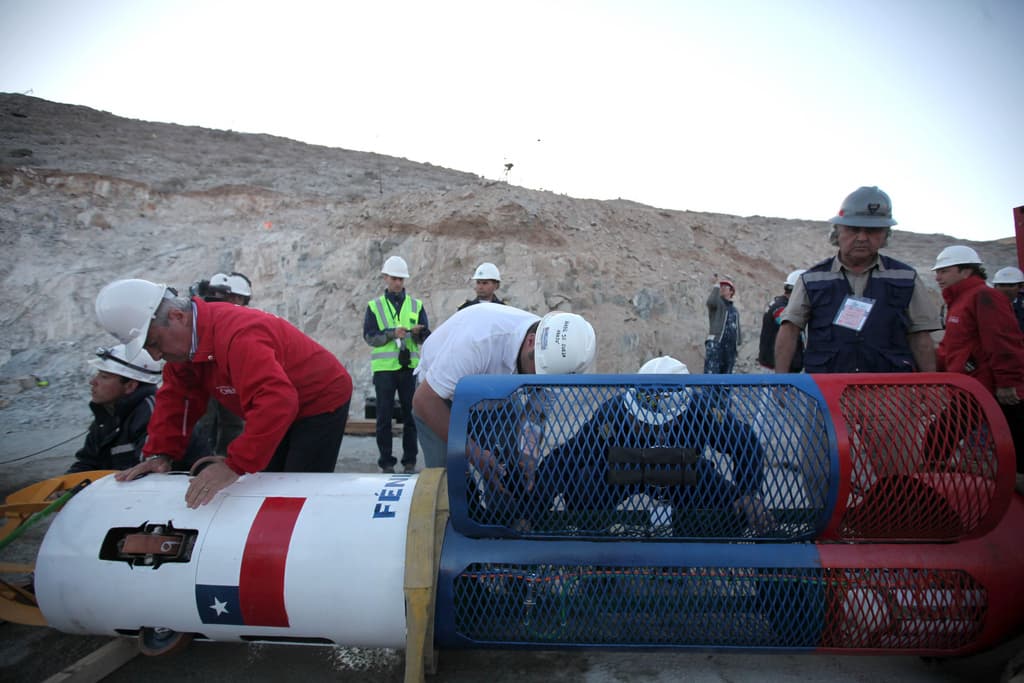
Los 33 — Sixty-Nine Days Under the Atacama and the '34th Miner' (2010)
Photo: Gobierno de Chile / Wikimedia Commons · CC BY 2.0
The story
Skip to the verdict ↓On 5 August 2010, a slab of rock as heavy as two Empire State Buildings tore loose deep inside the century-old San José mine in Chile's Atacama Desert and sealed the way out. Thirty-three men were seven hundred metres below it, in a refuge stocked with a few days' food. For seventeen days, the surface heard nothing at all.
Thirty-four men were inside the San Jose copper-gold mine when the rock sheared loose; one escaped. The remaining 33 were led by shift foreman Luis Urzua.
Through the blind 17 days the men ate two spoonfuls of tuna and a sip of milk every 48 hours, drank water stored for machinery, and organized themselves into a functioning society: work shifts, a daily assembly, and twice-daily prayers led by Jose Henriquez, an evangelical drill operator the men called the Pastor. Above, drill rigs punched exploratory boreholes through rock that outdated maps made treacherous. Seven probes missed. On August 22 the eighth broke through at a ramp beside the refuge, and when the drillers pulled the bit back up, a note was taped to it in red letters: We are well in the Refuge, the 33.
Over the following weeks, three parallel drilling plans raced to open a human-sized shaft while supplies, letters, and a video link traveled the boreholes. The rescue shaft drew on world-class engineering, NASA consultation, and a purpose-built capsule. Nineteen-year-old Jimmy Sanchez sent up a letter with a line that traveled the world: there were actually 34 of them down there, because God had never left them. On October 12 and 13, the Fenix 2 capsule hauled the men up one by one before an estimated billion viewers. Several knelt as they emerged. All 33 survived 69 days at depth, in 90-plus degree heat, with no deaths and no serious lasting physical injuries.
It happened — best read as remarkable timing, not the miraculous.
Reviewer Notes
Miracles Jar weighs each claim two ways — how extraordinary it would be, and how strong the evidence is.
Assessed by Miracles Jar AI
Exhaustively documented zero-fatality rescue; discipline, regulation, engineering, and persistence explain each link, while the miners' own '34th miner' testimony made it the decade's iconic providence story.
The verdict: Exhaustively documented zero-fatality rescue; discipline, regulation, engineering, and persistence explain each link, while the miners' own "34th miner" testimony made it the decade's iconic providence story.
The natural reading is unusually complete. The refuge, rations, and water existed because regulation required them. The rationing discipline that stretched three days of food to 17 was human leadership — the episode is now taught as a management case study (a Harvard Business School teaming case study). The probes found the men because a systematic search with multiple rigs kept drilling until one hit; outdated mine maps made the misses routine, so the breakthrough location was fortunate but the search was systematic. The rescue shaft was world-class engineering with NASA consultation, three simultaneous drilling plans, and a purpose-built capsule. Nothing in the chain lacks a mechanism.
The honest assessment of whether the arrangement was more than coincidence lands low. Every link is explicable, and a national mobilization with effectively unlimited resources is the machine that converts long odds into outcomes. The zero-fatality outcome over 69 days at 700 meters is extraordinary in mining history — it has no precedent at that scale — but the machinery of explanation is visible end to end. This sits low on the more-than-coincidence scale while standing as the defining modern providence narrative of the Spanish-speaking world.
What the entry records alongside that is the texture of the event: the miners did not experience engineering, they experienced deliverance, said so in writing while still entombed, and emerged praying. The 34th miner is the rare providence claim made contemporaneously, in the dark, by the people with the most at stake — the providence framing came from inside the mine, lived rather than retrofitted.
Evidence:
1. All 33 survived 69 days, including 17 days on roughly three days of rations with no outside contact — confirmed by the Chilean government, rescue engineers, and global press. The event is beyond dispute; the question is interpretation. 2. Survival through the blind 17 days traces to identifiable causes — code-required refuge, emergency rations, water from industrial tanks, Urzúa's strict rationing discipline. Competence, not anomaly. 3. Seven boreholes missed before the eighth broke through at the refuge ramp on day 17, outdated maps making misses routine. Persistence across multiple drill rigs explains the find. 4. The miners' contemporaneous testimony — Sánchez's "34 of us" letter, Henríquez's twice-daily prayer services — frames the providence reading from inside the event. Evidentially neutral, but documents that the interpretation was lived, not retrofitted. 5. Zero deaths and no serious lasting physical injuries after 69 days at 700 meters in 90-plus-degree heat, with no precedent at that scale. The believer-side core, but engineering and luck remain sufficient on the natural side.
Evidence ledger — what the verdict rests on
All 33 men survived 69 days at depth, including 17 days on roughly three days of rations with no outside contact, and every fact is confirmed by the Chilean government, rescue engineers, and global press
The event is beyond dispute; the question is interpretation
Survival through the blind 17 days traces to identifiable causes: a code-required refuge, emergency rations, water from industrial tanks, and Luis Urzua's strict rationing discipline
The group's self-organization became a Harvard Business School teaming case study — competence, not anomaly
Seven probe boreholes missed before the eighth broke through at the refuge ramp on day 17, with outdated mine maps making misses routine
Persistence across multiple drill rigs explains the find; the breakthrough location was fortunate but the search was systematic
The miners' own contemporaneous testimony — Sanchez's '34 of us' letter, Henriquez's twice-daily prayer services — frames the providence reading from inside the event rather than in retrospect
Evidentially neutral but documents that the miracle interpretation was lived, not retrofitted
Zero deaths and no serious lasting physical injuries after 69 days at 700 meters in 90-plus degree heat has no precedent at that scale in mining history
The conjunction is the believer-side core; engineering and luck remain sufficient on the natural side
What would raise the meter: Independent documentation shrinking the coincidence window (timestamps, third-party records) would move this.
What would lower it: Evidence the timing window was wider than reported would move it down.
How we weigh every claim — the full method, deductions and all →
The natural explanation
The leading natural account for this case is coincidence & the law of truly large numbers. Read what it explains — and where it stops.
The same wonder, across traditions
This claim is one of many that make the same assertion across faiths. See it side by side in Deliverance Against the Odds.
Sources
Tagged by proximity to the event. Primary sources are direct or contemporaneous; tertiary are downstream retellings.
- 1.Tertiaryother
Comprehensive sourced timeline: collapse, rationing, August 22 borehole breakthrough, October 13 rescue
- 2.Secondarynews
Based on Tobar's book written with exclusive access to all 33 miners; covers the spiritual life of the group underground
- 3.Tertiaryother
Encyclopaedia Britannica, "Chile mine rescue of 2010", 2010
Independent reference confirmation of dates, depths, and rescue sequence
- 4.Secondarynews
Christianity Today, "Chilean Miner: 'God Has Never Left Us'", 2010
Documents Jimmy Sanchez's letter counting God as the 34th miner
- 5.Secondarynews
Religion Dispatches, "God, 'The 34th Miner' in Chilean Ordeal", 2010
Analysis of the religious framing as it emerged in real time, including Catholic and evangelical strands among the miners
- 6.Secondarynews
TIME, "Chile's Mine Rescue: Media and Pilgrims Await a Miracle", 2010
Contemporaneous Camp Hope reporting on the vigil culture around the rescue
Cases like this
Nearest on the map — similar in how miraculous they’d be, and how strong the evidence is.